

Greenlee
Plumbing
Google Search
Call Tracking
Paid Advertising
Lead Generation
When we took on this client, the account had minimal prior activity — a single campaign that had been running for a couple of weeks before we came on board, and some organic brand presence, but no intentional paid search architecture built around the client's actual service mix. The goal was to build a properly segmented search presence for a plumbing contractor with strong service differentiators: a 25-year no-leak warranty, one-day whole-home repiping, and $0-down financing.
Nine weeks later, we had driven 332 inbound calls across channels, taken non-branded search CPA from $406 down to $160, and restructured the account to reflect what the data was
actually telling us about how homeowners search for these services.


The account launched with a single existing campaign targeting pipe material replacements. Over the following nine weeks, we built it into a segmented search architecture covering the client's three core service areas — whole-home repiping, leak detection, and water heater replacement — each with dedicated campaigns, ad groups, and landing pages.
W E E K 1 — M A R 2 3
Repipe campaign built out as the primary campaign, housing multiple ad groups covering core repipe intent, pipe material replacement, leak detection, slab leak terms, and pipe replacement. The Leak Detection ad group was doing double duty — serving both leak- specific searches and supporting the broader repipe funnel from a single budget.
W E E K S 1 – 2
The existing pipe material campaign continued running while we evaluated overlap and performance. After two weeks, the strongest converting keywords were folded into Repipe's dedicated ad group and the campaign was paused.
W E E K 3 — A P R 6
The Water Heater campaign comes online, a logical extension of the client's service menu. Branded search was also formally structured at this stage, capturing existing name recognition that had previously gone unpaid.
W E E K 5 — A P R 2 0
Leaks carved out as its own campaign. The Leak Detection ad group inside Repipe had been generating enough conversion signal to warrant dedicated budget and strategy. Separating it gave us cleaner performance controls and prevented leak-specific searches from competing with repipe searches for the same daily budget.
M A Y 1 5 – 1 8
Major restructure: two new ad groups built inside Leaks (Slab Leaks and Mainline/Yard Line), new responsive search ads across all active campaigns, and both Repipe and Leaks shifted to Target CPA bid strategies. Water Heater temporarily paused, budget reallocated.
Full details below.
How the account was structured
Back To All Projects
R E P I P E
Repipe was the account's workhorse from day one, housing everything at launch — core repipe searches, pipe material keywords, leak detection, slab leak terms, and general pipe
replacement intent. The broad initial scope was intentional: with minimal conversion history to inherit, casting a wider net early helps the algorithm gather signal faster.
As the account matured and data accumulated, we segmented. Leak Detection was pulled into its own campaign in week five. The remaining Repipe ad groups stayed focused on the highest-
value intent: whole-home repipe, cost-based searches, and pipe-material-specific replacement. CPA within the Repipe campaign trended from $523 in its first active week to $229 at its best.
L E A K S
The Leaks campaign was created in week five by separating the Leak Detection ad group from Repipe. Running both service types under a single campaign budget meant they were competing for spend rather than each being optimized independently. Leak detection and whole-home repiping are different conversion journeys — different search language, different decision timelines, different landing pages — and they benefit from being managed separately.
After the separation, Leaks grew steadily: $786 in spend week five, reaching $1,600 by week nine. The May restructure expanded it substantially — two new ad groups were built to capture search intent that had been partially matched but not specifically targeted:
• Slab Leaks — targeting leaks originating under a home's concrete foundation, which carry distinct search language and urgency
• Mainline / Yard Line — targeting failures in the buried service line between the street meter and the house, a separate diagnosis with its own set of search terms
With Repipe paused, Leaks is now the primary active non-branded campaign. Daily budget was increased from $100 to $225 to support the expanded scope and give the new Target CPA strategy enough room to operate.
Campaign by campaign
In mid-May, the client secured a commercial job for a large multi-unit property, temporarily shifting available capacity away from new residential leads. Repipe was paused at that point, with budget reallocated to Leaks and Water Heater.
The CPA range across non-branded campaigns ($270–$672) reflects the range of service categories and where each sits in the learning curve. High-intent, high-specificity searches convert more efficiently — which is why Leaks outperforms Water Heater, even though both are plumbing services. The category of search matters as much as the budget behind it.
Overall Account Performance

By early May, the account had six weeks of conversion data — enough to shift from collecting signal to optimizing toward a target. The May 15th–18th changes were the most concentrated set of decisions in the nine-week window:
New ad groups in Leaks. Search term data showed two distinct intent clusters that the existing single Leak Detection ad group couldn't serve well simultaneously. Slab leak searches and
mainline/yard line searches use different language, land on different pages, and describe different problems. Splitting them into dedicated ad groups with tailored responsive search ads
immediately improved ad relevance.
Bid strategy shift to Target CPA. Both Repipe and Leaks moved from Maximize Conversions to Target CPA — Repipe at a $375 target with a $125 max bid cap, Leaks under a shared tCPA strategy. This requires enough historical data to work from, which is why we waited until week six to make the switch.
Budget rebalancing. The Leaks budget increased from $100/day to $225/day. At $100/day against a ~$270 average CPA, the campaign could realistically only generate one lead every three days — not enough volume for the algorithm to learn efficiently.
The May Restructure
Greenlee Plumbing
Google Search
Call Tracking
Paid Advertising
Lead Generation
When we took on this client, the account had minimal prior activity — a single campaign that had been running for a couple of weeks before we came on board, and some organic brand presence, but no intentional paid search architecture built around the client's actual service mix. The goal was to build a properly segmented search presence for a plumbing contractor with strong service differentiators: a 25-year no-leak warranty, one-day whole-home repiping, and $0-down financing.
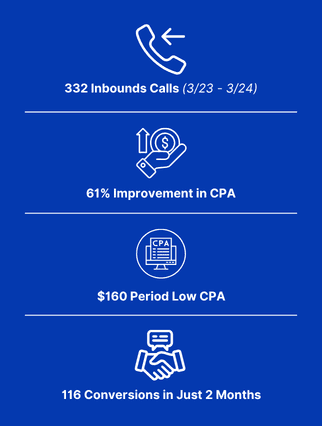
Nine weeks later, we had driven 332 inbound calls across channels, taken non-branded search CPA from $406 down to $160, and restructured the account to reflect what the data was actually telling us about how homeowners search for these services.
How the account was structured
The account launched with a single existing campaign targeting pipe material replacements. Over the following nine weeks, we built it into a segmented search architecture covering the client's three core service areas — whole-home repiping, leak detection, and water heater replacement — each with dedicated campaigns, ad groups, and landing pages.
W E E K 1 — M A R 2 3
Repipe campaign built out as the primary campaign, housing multiple ad groups covering core repipe intent, pipe material replacement, leak detection, slab leak terms, and pipe replacement. The Leak Detection ad group was doing double duty — serving both leak- specific searches and supporting the broader repipe funnel from a single budget.
W E E K S 1 – 2
The existing pipe material campaign continued running while we evaluated overlap and performance. After two weeks, the strongest converting keywords were folded into Repipe's dedicated ad group and the campaign was paused.
W E E K 3 — A P R 6
The Water Heater campaign comes online, a logical extension of the client's service menu. Branded search was also formally structured at this stage, capturing existing name recognition that had previously gone unpaid.
W E E K 5 — A P R 2 0
Leaks carved out as its own campaign. The Leak Detection ad group inside Repipe had been generating enough conversion signal to warrant dedicated budget and strategy. Separating it gave us cleaner performance controls and prevented leak-specific searches from competing with repipe searches for the same daily budget.
M A Y 1 5 – 1 8
Major restructure: two new ad groups built inside Leaks (Slab Leaks and Mainline/Yard Line), new responsive search ads across all active campaigns, and both Repipe and Leaks shifted to Target CPA bid strategies. Water Heater temporarily paused, budget reallocated.
Full details below.
Campaign by campaign
The first two weeks of a newly structured account are always expensive. With limited conversion history and no prior architecture to learn from, the algorithm operates in the dark. Weeks 1–2 came in at $406 and $468 non-branded CPA respectively — expected friction for a cold start, but a clear baseline to beat.
From week 3 onward, the improvement was consistent and meaningful. By week six (April 27), non-branded CPA had reached $160. That's the result of accumulated conversion signals, tighter keyword architecture, and the Leaks campaign beginning to contribute its own volume as a standalone.
CPA trajectory: what the learning curve actually looks like


The strongest ad group over the period was Mainline/Yard Line, generating 17 conversions on $5,200 in spend — a $306 CPA in a service category where $400+ is common. That signal directly informed the decision to give mainline searches a dedicated home in the Leaks campaign during the May restructure.
The strongest ad group over the period was Mainline/Yard Line, generating 17 conversions on $5,200 in spend — a $306 CPA in a service category where $400+ is common. That signal directly informed the decision to give mainline searches a dedicated home in the Leaks campaign during the May restructure.
P I P E M A T E R I A L C A M P A I G N
This campaign — targeting homeowners with a specific aging pipe material common in homes built during a particular era — was already running in a limited form when we took on the account. We continued it for two weeks while evaluating performance. It generated 8 conversions on $4,550 in spend ($569 CPA), but the search intent overlapped substantially with the Repipe campaign's existing ad groups. Rather than maintaining a standalone campaign for that overlap, we folded the strongest converting keywords into Repipe's dedicated ad group and paused the campaign.
W A T E R H E A T E R
The Water Heater campaign ran from weeks 3–8, generating 3 conversions on $2,015. The $672 average CPA reflects the dynamics of this search category: high CPCs, broad intent
(informational research vs. emergency replacement vs. scheduled install), and a competitive landscape. The two weeks that did produce conversions came in at $206 and $405, showing the efficiency that's achievable when the right search matches the right ad. The campaign was paused in mid-May as part of the budget rebalancing, and has since been reactivated.
The week of May 18th shows CPA spiking back to $273 — the highest since week two. This is expected behavior after a restructure. New ad groups need time to earn Quality Score and impression share. Target CPA strategies require roughly 30–50 conversions per strategy to exit the learning phase. The spike is the cost of building a better long-term structure, not a sign that something broke.
Across 2,841 unique search terms over the nine-week period, the clearest pattern was that specificity predicts conversion. High-specificity terms — those that name a problem, a service type, and often a location — convert at meaningfully higher rates than broad category searches.
On the non-branded side, the gap between specific and generic is stark. "Leak detection company near me" generated 5 conversions. "Plumbers near me" generated zero on 9 clicks
and $402 in spend. The person who searches for a leak detection company has already diagnosed their problem and is evaluating providers. The person searching for "a plumber near me" is still figuring out what they need. These are different stages of the buying journey, and they shouldn't share keywords, ad groups, or budgets.
What the search term data tells us
The immediate priority is giving the Target CPA strategies time to stabilize after the mid-May restructure. Both Leaks and Water Heater need to accumulate roughly 30–50 conversions per
strategy before the algorithm can optimize reliably — Leaks is closest to that threshold, Water Heater will take longer.
When the commercial project winds down and residential capacity reopens, the Repipe campaign comes back online. By that point, the new Cost + Comparison ad group will have had time to gather early impression data, and the Slab Leaks and Mainline/Yard Line groups in Leaks will carry cleaner signals into the transition.
The open question is Water Heater. At a $672 CPA it needs improvement to justify its place in the account alongside higher-performing campaigns. The reactivation gives it another evaluation window — if the next four to six weeks show it trending toward the $200–$300 range, it stays and scales. If not, the budget is better deployed elsewhere.
Where the account stands and what's next
CPA trajectory: what the learning curve actually looks like
The first two weeks of a newly structured account are always expensive. With limited conversion history and no prior architecture to learn from, the algorithm operates in the dark. Weeks 1–2 came in at $406 and $468 non-branded CPA respectively — expected friction for a cold start, but a clear baseline to beat.
From week 3 onward, the improvement was consistent and meaningful. By week six (April 27), non-branded CPA had reached $160. That's the result of accumulated conversion signals, tighter keyword architecture, and the Leaks campaign beginning to contribute its own volume as a standalone.
R E P I P E
Repipe was the account's workhorse from day one, housing everything at launch — core repipe searches, pipe material keywords, leak detection, slab leak terms, and general pipe
replacement intent. The broad initial scope was intentional: with minimal conversion history to inherit, casting a wider net early helps the algorithm gather signal faster.
As the account matured and data accumulated, we segmented. Leak Detection was pulled into its own campaign in week five. The remaining Repipe ad groups stayed focused on the highest- value intent: whole-home repipe, cost-based searches, and pipe-material-specific replacement. CPA within the Repipe campaign trended from $523 in its first active week to $229 at its best.
In mid-May, the client secured a commercial job for a large multi-unit property, temporarily shifting available capacity away from new residential leads. Repipe was paused at that point, with budget reallocated to Leaks and Water Heater.
L E A K S
The Leaks campaign was created in week five by separating the Leak Detection ad group from Repipe. Running both service types under a single campaign budget meant they were competing for spend rather than each being optimized independently. Leak detection and whole-home repiping are different conversion journeys — different search language, different decision timelines, different landing pages — and they benefit from being managed separately.
After the separation, Leaks grew steadily: $786 in spend week five, reaching $1,600 by week nine. The May restructure expanded it substantially — two new ad groups were built to capture search intent that had been partially matched but not specifically targeted:
• Slab Leaks — targeting leaks originating under a home's concrete foundation, which carry distinct search language and urgency
• Mainline / Yard Line — targeting failures in the buried service line between the street meter and the house, a separate diagnosis with its own set of search terms
With Repipe paused, Leaks is now the primary active non-branded campaign. Daily budget was increased from $100 to $225 to support the expanded scope and give the new Target CPA strategy enough room to operate.
W A T E R H E A T E R
The Water Heater campaign ran from weeks 3–8, generating 3 conversions on $2,015. The $672 average CPA reflects the dynamics of this search category: high CPCs, broad intent
(informational research vs. emergency replacement vs. scheduled install), and a competitive landscape. The two weeks that did produce conversions came in at $206 and $405, showing the efficiency that's achievable when the right search matches the right ad. The campaign was paused in mid-May as part of the budget rebalancing, and has since been reactivated.
Overall Account Performance
The CPA range across non-branded campaigns ($270–$672) reflects the range of service categories and where each sits in the learning curve. High-intent, high-specificity searches convert more efficiently — which is why Leaks outperforms Water Heater, even though both are plumbing services. The category of search matters as much as the budget behind it.
The May Restructure
The week of May 18th shows CPA spiking back to $273 — the highest since week two. This is expected behavior after a restructure. New ad groups need time to earn Quality Score and impression share. Target CPA strategies require roughly 30–50 conversions per strategy to exit the learning phase. The spike is the cost of building a better long-term structure, not a sign that something broke.
Across 2,841 unique search terms over the nine-week period, the clearest pattern was that specificity predicts conversion. High-specificity terms — those that name a problem, a service type, and often a location — convert at meaningfully higher rates than broad category searches.
On the non-branded side, the gap between specific and generic is stark. "Leak detection company near me" generated 5 conversions. "Plumbers near me" generated zero on 9 clicks and $402 in spend. The person who searches for a leak detection company has already diagnosed their problem and is evaluating providers. The person searching for "a plumber near me" is still figuring out what they need. These are different stages of the buying journey, and they shouldn't share keywords, ad groups, or budgets.
What the search term data tells us
The immediate priority is giving the Target CPA strategies time to stabilize after the mid-May restructure. Both Leaks and Water Heater need to accumulate roughly 30–50 conversions per
strategy before the algorithm can optimize reliably — Leaks is closest to that threshold, Water Heater will take longer.
When the commercial project winds down and residential capacity reopens, the Repipe campaign comes back online. By that point, the new Cost + Comparison ad group will have had time to gather early impression data, and the Slab Leaks and Mainline/Yard Line groups in Leaks will carry cleaner signals into the transition.
The open question is Water Heater. At a $672 CPA it needs improvement to justify its place in the account alongside higher-performing campaigns. The reactivation gives it another evaluation window — if the next four to six weeks show it trending toward the $200–$300 range, it stays and scales. If not, the budget is better deployed elsewhere.
Where the account stands and what's next
By early May, the account had six weeks of conversion data — enough to shift from collecting signal to optimizing toward a target. The May 15th–18th changes were the most concentrated set of decisions in the nine-week window:
New ad groups in Leaks. Search term data showed two distinct intent clusters that the existing single Leak Detection ad group couldn't serve well simultaneously. Slab leak searches and mainline/yard line searches use different language, land on different pages, and describe different problems. Splitting them into dedicated ad groups with tailored responsive search ads
immediately improved ad relevance.
Bid strategy shift to Target CPA. Both Repipe and Leaks moved from Maximize Conversions to Target CPA — Repipe at a $375 target with a $125 max bid cap, Leaks under a shared tCPA strategy. This requires enough historical data to work from, which is why we waited until week six to make the switch.
Budget rebalancing. The Leaks budget increased from $100/day to $225/day. At $100/day against a ~$270 average CPA, the campaign could realistically only generate one lead every three days — not enough volume for the algorithm to learn efficiently.
P I P E M A T E R I A L C A M P A I G N
This campaign — targeting homeowners with a specific aging pipe material common in homes built during a particular era — was already running in a limited form when we took on the account. We continued it for two weeks while evaluating performance. It generated 8 conversions on $4,550 in spend ($569 CPA), but the search intent overlapped substantially with the Repipe campaign's existing ad groups. Rather than maintaining a standalone campaign for that overlap, we folded the strongest converting keywords into Repipe's dedicated ad group and paused the campaign.